
PFF Keycaps Profile
PFF (Penguin Flat Feet) is a uniform, low-profile MX keycap profile designed by matt3o and manufactured by Keyreative. At just 5mm tall (5.7mm including the stem), it was built from scratch for low-profile MX switches, not adapted from an existing profile. The top surface combines cylindrical front-to-back curvature with a spherical scoop, the same geometry used in matt3o's PBS profile, scaled down to fit a completely different class of keyboard. The result is one of the few low-profile MX keycaps that actually prioritizes ergonomic finger contact rather than settling for a flat slab.
PFF Specifications
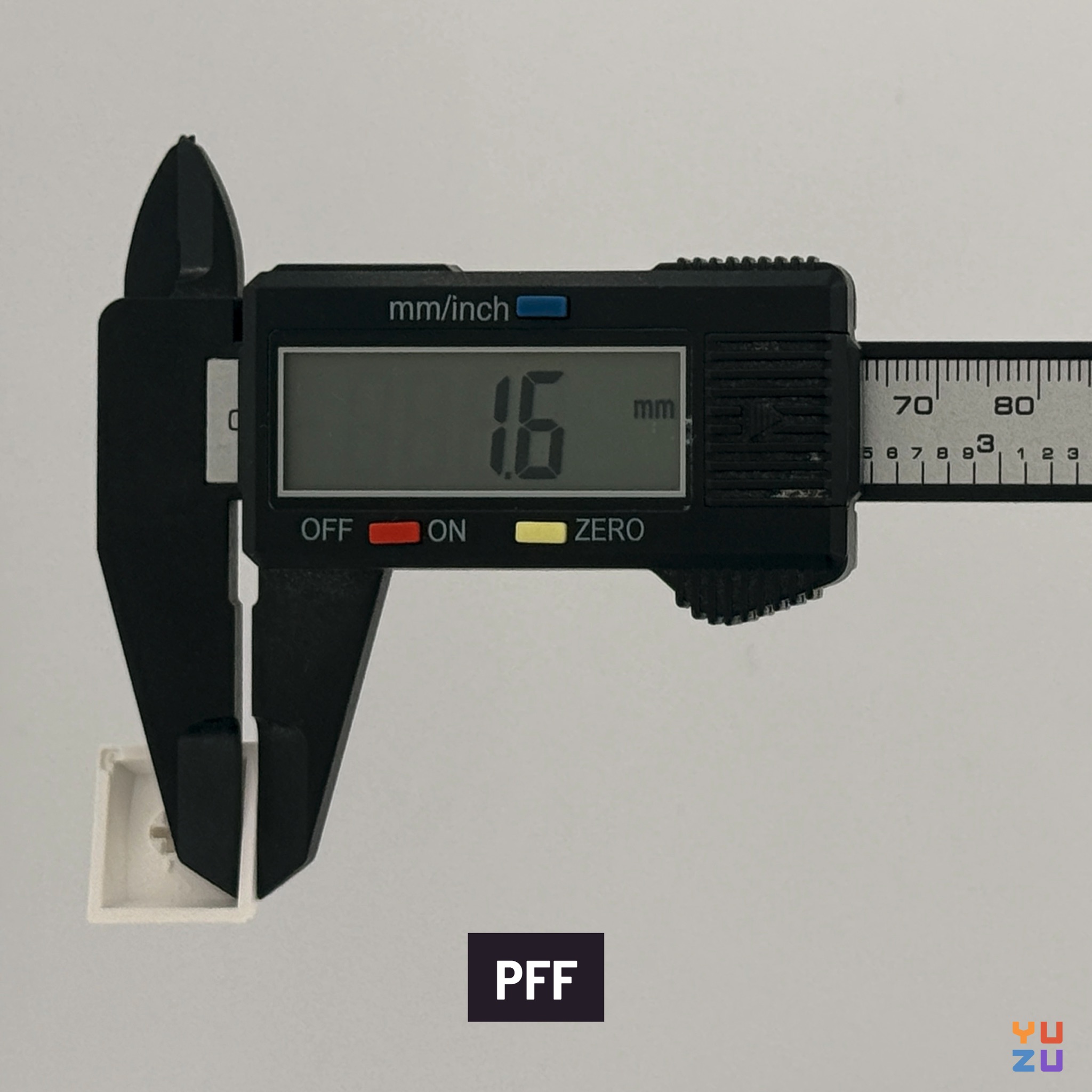
Sculpted or uniform?
PFF is a uniform profile. Every key shares the same height and top surface shape, regardless of which row it sits in. You can place any PFF keycap in any position on the keyboard and it will look and feel identical to its neighbors.
For low-profile keyboards, this is the right default. Many low-profile boards run compact or unconventional layouts. 60%, 65%, split, and ortholinear configurations are all common in this space. A sculpted profile would lock keys to specific rows, causing mismatched angles the moment you rearrange anything. PFF's uniform design means full layout freedom: it works just as well on a standard 75% as it does on a column-stagger split or a 40% ortho board.
One detail worth knowing: bottom row keycaps in PFF are convex rather than concave. Where the rest of the set scoops inward to cradle fingertips, the bottom row curves outward to better fit thumb contact. Most PFF sets ship with convex bottom row keys included. On Yuzu, you can choose between convex and concave bottom row depending on your preference or thumb cluster layout.
The tradeoff of a uniform profile is the same as always: no row-by-row height variation to help fingers find their position by feel. For most users, especially those coming from laptop keyboards or other flat-profile setups, this is not a meaningful loss. The ergonomic scoop on each keycap's top surface compensates by guiding fingertips toward center on every strike.
Custom PFF keycaps on Yuzu
PFF is available on Yuzu, which means you can design exactly the set you need rather than waiting for a group buy to open or hunting down in-stock options that may not match your board or colorway.
Every PFF set on Yuzu is made to order with dye-sublimated PBT, the same production method that gives PBT its durability and color accuracy. Choose from Yuzu's curated color palette, set your own legends, and cover whatever layout your low-profile board runs. There's no minimum order, no fixed colorways to pick from, and no wait on a production run that may be months away.
One option unique to Yuzu: you can choose whether your bottom row keycaps are convex or concave. Most PFF sets ship with convex bottom row keys as the default, which suits thumb contact on standard layouts. If your board has a thumb cluster or you simply prefer concave keys throughout, Yuzu lets you make that call per set.
If you're building out a low-profile setup and want keycaps that match an existing aesthetic or a specific color you have in mind, the Playground lets you design a full set from scratch.
Where PFF came from
Matt3o (Matteo Spinelli) announced PFF in October 2025, positioning it as a direct companion to his PBS profile rather than a derivative of it. Where PBS reimagined what a uniform MX profile could feel like at standard height, PFF applied the same philosophy to a different problem: the low-profile MX switch category had no keycap profile designed specifically for it.
The low-profile MX market had grown steadily through the early 2020s, driven by boards from Keychron, NuPhy, and others. But the keycap options available to those boards were either standard MX caps sitting awkwardly on shorter switches, or flat slabs with no ergonomic surface geometry. Matt3o's starting point was direct: a low-profile keycap has to be crafted for low-profile switches, not adapted from something else.
PFF shares PBS's cylindrical-plus-spherical-scoop top geometry, keeping the fingertip contact that made PBS well received, but rebuilds everything else from scratch. The H-shaped internal cavity is a PFF-specific engineering detail, designed to clear the stem geometry of Huano Low Profile switches used in many Keychron boards. The experimental fiberglass-infused PBT composite addresses a persistent manufacturing problem with low-profile keycaps: warping on larger keys like spacebars. The convex bottom row carries over from PBS, where it earned particular praise from split keyboard users working with thumb clusters.
Manufactured by Keyreative and sold through CannonKeys and a global vendor network, PFF was expected to ship in early 2026.
Adapting to PFF
The adjustment coming from standard MX keycaps is more noticeable than switching between most full-height profiles. At 5mm, PFF sits significantly lower than anything in the standard MX range: roughly half the height of Cherry profile, and about a third of SA. Fingers accustomed to lifting between keystrokes will need to recalibrate. The natural tendency to hover hands above the keys, built up over years of typing on OEM or Cherry profile boards, becomes unnecessary here.
Most typists find the low height feels immediately familiar if they've spent time on a laptop keyboard. The keytop-to-desk distance on PFF (~11.7mm) is close to what a modern thin laptop produces. If that's your baseline, PFF will feel natural from the first session.
Coming from a taller mechanical profile like OEM, SA, or MT3 typically takes a few days of active use rather than weeks. The main adjustment is finger height: less lift, more glide. Touch typists may briefly feel less row differentiation since PFF is uniform rather than sculpted, but the spherical top scoop provides enough tactile centering that most users stop noticing this within the first week.
The convex bottom row is worth a specific mention for anyone using thumb keys. Where concave keycaps scoop inward to receive a fingertip pressing downward, convex keys curve outward to meet a thumb pressing inward or at an angle. If you're coming from a standard keyboard, the bottom row will feel different under your thumbs compared to the rest of the set. Most users adapt quickly, and many find the convex shape more natural for spacebar use once they've adjusted.
One practical note: low-profile boards are often used without a wrist rest, relying on reduced hand elevation for ergonomic benefit. PFF preserves that. Pairing it with a thick wrist rest would partially offset the advantage of going low-profile in the first place.
Community resources
PFF is a newer profile with a growing community presence. The primary discussion happens through CannonKeys' channels and matt3o's community spaces, where early users have shared typing sound tests and build photos.
For anyone interested in the engineering decisions behind the H-shaped cavity, the fiberglass-composite PBT, and the design rationale for building PFF from scratch rather than adapting PBS, matt3o documented his thinking publicly at the time of the October 2025 announcement. His full write-up is available at matt3o.com.
As more sets ship and the community grows, documentation on switch compatibility across specific boards and spacebar warp performance with the new PBT composite is expected to expand. The Yuzu Discord server is a useful place to ask questions about PFF compatibility with specific boards and connect with others building with the profile.
Dimensioni PFF disponibili su Yuzu
Profili copritasti disponibili su Yuzu
Il profilo Cherry è il profilo standard quando si parla di copritasti per tastiere meccaniche. È profilato, il che significa che ogni riga ha un'altezza e una forma diverse, per consentire il massimo comfort di digitazione. Scegli questa opzione se non sei sicuro di quale profilo preferisci.
Il profilo KAM è stato creato da Keyreative. È piatto, il che significa che tutte le righe hanno la stessa altezza e forma, per consentire la massima compatibilità nello scambiare i tasti tra righe e tastiere diverse. Scegli questa opzione se hai familiarità con KAM o preferisci la sensazione di digitazione di DSA/XDA che sono profili di copritasti piatti simili.
PFF è un profilo copritasto cilindrico progettato specificamente per gli switch meccanici a basso profilo. Risponde ai requisiti unici delle tastiere a basso profilo mantenendo i vantaggi tattili dei copritasti profilati per una migliore esperienza di digitazione.
PBS utilizza una combinazione di un fronte e retro cilindrici con una parte superiore a sfera. Il risultato è un'ampia area di contatto scavata in cima, che consente un'esperienza di digitazione comoda ed ergonomica.
Il profilo KLP Lamé è stato progettato da braindefender appositamente per le tastiere ergonomiche. È disponibile nelle versioni MX e Choc per adattarsi alla maggior parte delle tastiere split.