
PBS keycap profile
PBS (Penguin Belly Slide) is a uniform keycap profile designed by matt3o and manufactured by Keyreative. Standing at approximately 7.5mm tall, it sits in the same low-profile range as DSA but with a fundamentally different top surface: a hybrid geometry that combines cylindrical front-to-back curvature with a spherical scoop, creating wider, more inviting finger contact than a traditional shallow dish. Every row is identical, so keys can go anywhere on any layout. PBS launched commercially around 2022 and has since earned a strong reputation as the best uniform profile available for MX switches, the answer to a question DSA users didn't know they had.
PBS Specifications
Sculpted or uniform?
PBS is a uniform profile: every keycap shares the same height and angle, regardless of which row it sits on. This is the defining compatibility advantage. On a standard staggered keyboard, it means you can swap keys between rows freely. On split, ortholinear, or columnar-stagger layouts, it means you never have to think about row assignment at all. PBS works on all of them straight out of the kit.
The tradeoff is that uniform profiles offer no ergonomic guidance from row to row. There's no sculpted wave pulling your fingers into alignment the way Cherry or SA does. For many typists, especially those on non-standard layouts or who touch-type comfortably, this is a non-issue. For typists who rely on that physical differentiation as a homing reference, a sculpted profile may suit them better.
Where PBS distinguishes itself from other uniform options is that the loss of sculpting doesn't mean a loss of finger comfort. The hybrid cylindrical-plus-spherical top surface still cradles fingertips at center. The bottom row is available in both convex and concave versions: the convex spacebar is shaped to follow the natural downward press of the thumb, which is more comfortable than a concave surface for a key that's pressed differently from every other key on the board. It's a considered geometry, not a flat compromise.
Design your own PBS keycaps on Yuzu
PBS is available on Yuzu, which means you're not waiting on a group buy or hoping a colorway you want shows up in stock somewhere. You design the set you actually want: your legends, your colors, your layout, and Yuzu produces it in dye-sublimated PBT.
That's useful for PBS in particular because the profile's uniform design makes it the right choice for a wide range of keyboards: 60% staggered boards, 65% and 75% layouts, split keyboards, ortholinear grids, and anything in between. Yuzu supports all of them. You can configure for a Planck, a Corne, an Alice layout, or a standard TKL without switching tools or sourcing add-on kits.
One detail worth knowing: on PBS, the bottom row spacebars are available in both convex and concave versions. The convex spacebar is shaped to match how thumbs naturally press down, which reduces strain on longer typing sessions. On Yuzu, you can choose which one you want when configuring your layout.
Where PBS came from
Matt3o has been one of the most influential keycap designers in the community. MT3 launched in 2018 on Drop and gave enthusiasts a high-profile alternative to SA. PBS came from a different place: dissatisfaction with the options available for low-profile uniform use.
DSA had been the default for ortho, split, and alternative-layout boards for years. It does the job, but matt3o felt the geometry was weak, a shallow dish that didn't do enough for fingertip contact or acoustic performance. His goal with PBS was to answer: what would DSA look like if it were designed from scratch today, with better materials, better geometry, and a proper manufacturing partner?
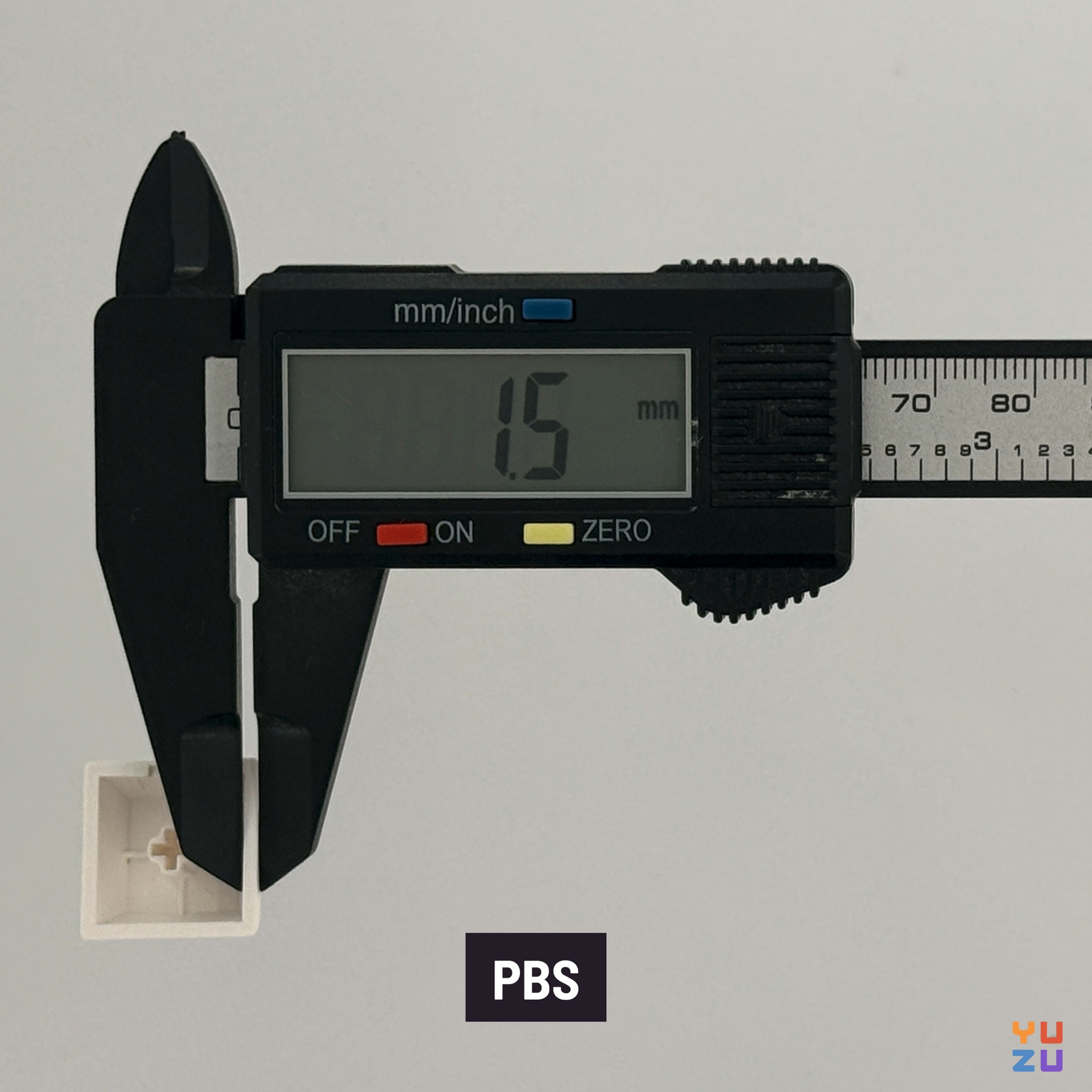
The result was PBS, manufactured by Keyreative (the same factory behind KAT and KAM), built from 1.5mm-wall PBT and shaped with the hybrid cylindrical-spherical scoop he had been refining through earlier profiles. PBS Granite, a direct port of matt3o's iconic DSA Granite colorway, was the first commercial set. You can read his original write-up at matt3o.com.
Adapting to PBS
At 7.5mm, PBS sits noticeably lower than OEM (about 11.5mm) and Cherry (about 9.4mm). If you're coming from a standard pre-built keyboard, the drop in height is the first thing you notice. Fingers rest closer to the board, and keytops feel slightly farther apart because there's less height to create that vertical separation.
Most typists adapt within a few days. The transition is significantly easier than moving to a very tall profile like SA or MT3, and no real technique adjustment is required. The profile rewards a relaxed, lower-effort typing style. Fingers don't need to lift as high between keypresses, which suits both fast typists who stay close to the board and anyone dealing with repetitive strain concerns.
For users switching from DSA specifically, PBS typically feels immediately better: more defined finger placement, deeper sound, and a more deliberate edge to each keytop.
ขนาด PBS ที่มีใน Yuzu
โปรไฟล์ฝาปุ่มที่มีใน Yuzu
โปรไฟล์ Cherry เป็นโปรไฟล์มาตรฐานสำหรับฝาปุ่มคีย์บอร์ดเมคานิคัล เป็นแบบปั้นรูป หมายความว่าแต่ละแถวมีความสูงและรูปร่างที่แตกต่างกัน เพื่อความสะดวกสบายสูงสุดในการพิมพ์ เลือกตัวเลือกนี้หากคุณไม่แน่ใจว่าต้องการโปรไฟล์ไหน
โปรไฟล์ KAM ถูกสร้างโดย Keyreative เป็นแบบแบน หมายความว่าทุกแถวมีความสูงและรูปร่างเดียวกัน เพื่อความเข้ากันได้สูงสุดในการสลับปุ่มข้ามแถวและคีย์บอร์ดที่แตกต่างกัน เลือกตัวเลือกนี้หากคุณคุ้นเคยกับ KAM หรือชอบความรู้สึกในการพิมพ์ของ DSA/XDA ซึ่งเป็นโปรไฟล์แบบแบนที่คล้ายกัน
PFF คือโปรไฟล์ฝาปุ่มทรงกระบอกที่ออกแบบมาเฉพาะสำหรับสวิตช์เมคานิคัลแบบ low-profile ตอบสนองความต้องการเฉพาะของคีย์บอร์ดเมคานิคัล low-profile พร้อมคงประโยชน์ด้านสัมผัสของฝาปุ่มแบบปั้นรูปไว้ เพื่อประสบการณ์การพิมพ์ที่ดียิ่งขึ้น
PBS ใช้การผสมผสานระหว่างด้านหน้าและด้านหลังทรงกระบอกกับส่วนโค้งทรงกลมด้านบน ผลลัพธ์คือพื้นที่สัมผัสที่เว้าลึกกว้างด้านบน ให้ประสบการณ์การพิมพ์ที่สะดวกสบายและเหมาะกับสรีรศาสตร์
โปรไฟล์ KLP Lamé ออกแบบโดย braindefender สำหรับคีย์บอร์ดเพื่อสุขภาพโดยเฉพาะ มีทั้งรุ่น MX และรุ่น Choc เพื่อให้เข้ากับคีย์บอร์ดแบบแยกได้เกือบทุกรุ่น