
PBS keycap profile
PBS (Penguin Belly Slide) is a uniform keycap profile designed by matt3o and manufactured by Keyreative. Standing at approximately 7.5mm tall, it sits in the same low-profile range as DSA but with a fundamentally different top surface: a hybrid geometry that combines cylindrical front-to-back curvature with a spherical scoop, creating wider, more inviting finger contact than a traditional shallow dish. Every row is identical, so keys can go anywhere on any layout. PBS launched commercially around 2022 and has since earned a strong reputation as the best uniform profile available for MX switches, the answer to a question DSA users didn't know they had.
PBS Specifications
Sculpted or uniform?
PBS is a uniform profile: every keycap shares the same height and angle, regardless of which row it sits on. This is the defining compatibility advantage. On a standard staggered keyboard, it means you can swap keys between rows freely. On split, ortholinear, or columnar-stagger layouts, it means you never have to think about row assignment at all. PBS works on all of them straight out of the kit.
The tradeoff is that uniform profiles offer no ergonomic guidance from row to row. There's no sculpted wave pulling your fingers into alignment the way Cherry or SA does. For many typists, especially those on non-standard layouts or who touch-type comfortably, this is a non-issue. For typists who rely on that physical differentiation as a homing reference, a sculpted profile may suit them better.
Where PBS distinguishes itself from other uniform options is that the loss of sculpting doesn't mean a loss of finger comfort. The hybrid cylindrical-plus-spherical top surface still cradles fingertips at center. The bottom row is available in both convex and concave versions: the convex spacebar is shaped to follow the natural downward press of the thumb, which is more comfortable than a concave surface for a key that's pressed differently from every other key on the board. It's a considered geometry, not a flat compromise.
Design your own PBS keycaps on Yuzu
PBS is available on Yuzu, which means you're not waiting on a group buy or hoping a colorway you want shows up in stock somewhere. You design the set you actually want: your legends, your colors, your layout, and Yuzu produces it in dye-sublimated PBT.
That's useful for PBS in particular because the profile's uniform design makes it the right choice for a wide range of keyboards: 60% staggered boards, 65% and 75% layouts, split keyboards, ortholinear grids, and anything in between. Yuzu supports all of them. You can configure for a Planck, a Corne, an Alice layout, or a standard TKL without switching tools or sourcing add-on kits.
One detail worth knowing: on PBS, the bottom row spacebars are available in both convex and concave versions. The convex spacebar is shaped to match how thumbs naturally press down, which reduces strain on longer typing sessions. On Yuzu, you can choose which one you want when configuring your layout.
Where PBS came from
Matt3o has been one of the most influential keycap designers in the community. MT3 launched in 2018 on Drop and gave enthusiasts a high-profile alternative to SA. PBS came from a different place: dissatisfaction with the options available for low-profile uniform use.
DSA had been the default for ortho, split, and alternative-layout boards for years. It does the job, but matt3o felt the geometry was weak, a shallow dish that didn't do enough for fingertip contact or acoustic performance. His goal with PBS was to answer: what would DSA look like if it were designed from scratch today, with better materials, better geometry, and a proper manufacturing partner?
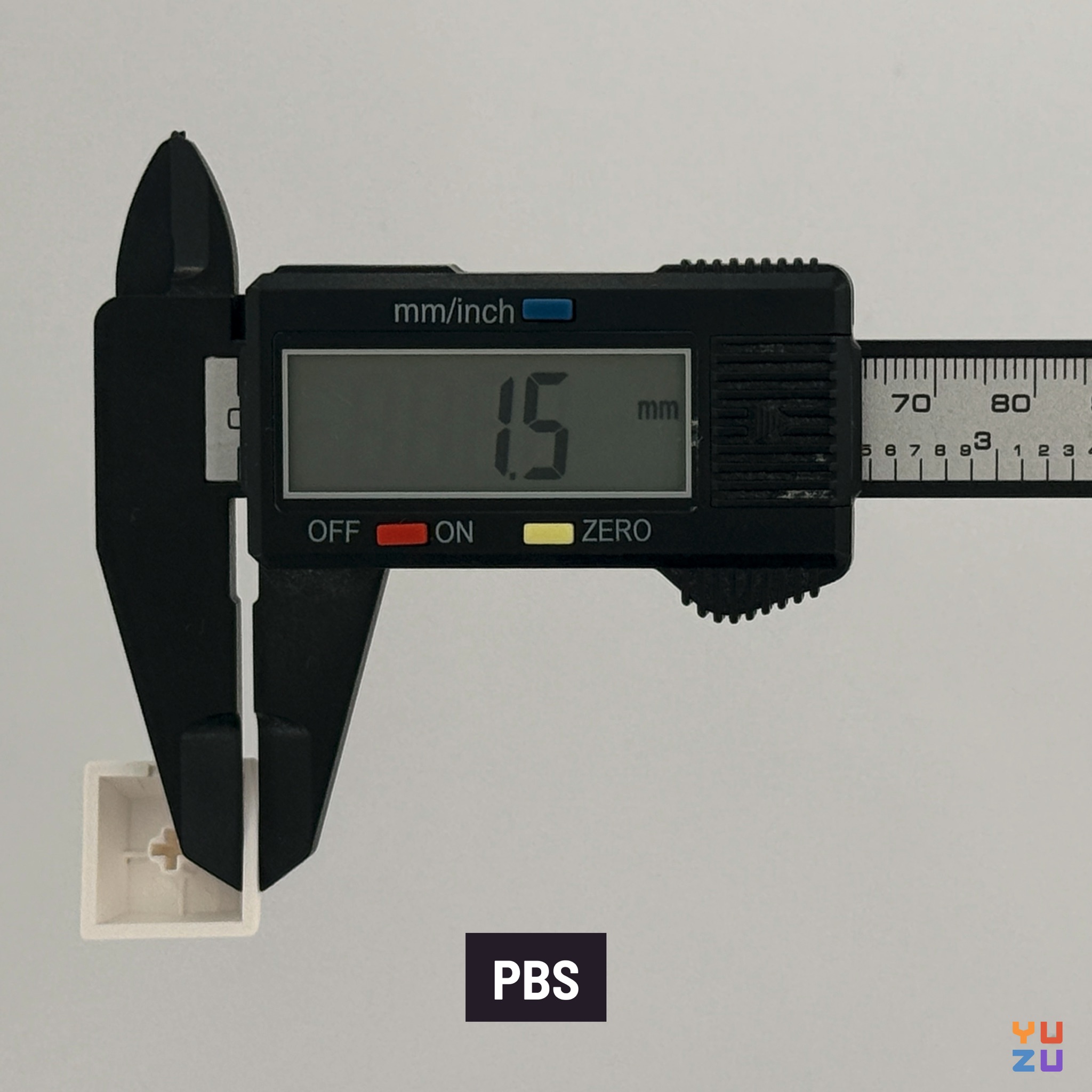
The result was PBS, manufactured by Keyreative (the same factory behind KAT and KAM), built from 1.5mm-wall PBT and shaped with the hybrid cylindrical-spherical scoop he had been refining through earlier profiles. PBS Granite, a direct port of matt3o's iconic DSA Granite colorway, was the first commercial set. You can read his original write-up at matt3o.com.
Adapting to PBS
At 7.5mm, PBS sits noticeably lower than OEM (about 11.5mm) and Cherry (about 9.4mm). If you're coming from a standard pre-built keyboard, the drop in height is the first thing you notice. Fingers rest closer to the board, and keytops feel slightly farther apart because there's less height to create that vertical separation.
Most typists adapt within a few days. The transition is significantly easier than moving to a very tall profile like SA or MT3, and no real technique adjustment is required. The profile rewards a relaxed, lower-effort typing style. Fingers don't need to lift as high between keypresses, which suits both fast typists who stay close to the board and anyone dealing with repetitive strain concerns.
For users switching from DSA specifically, PBS typically feels immediately better: more defined finger placement, deeper sound, and a more deliberate edge to each keytop.
Tailles PBS disponibles sur Yuzu
Stems de la barre d'espace PBS et compatibilité
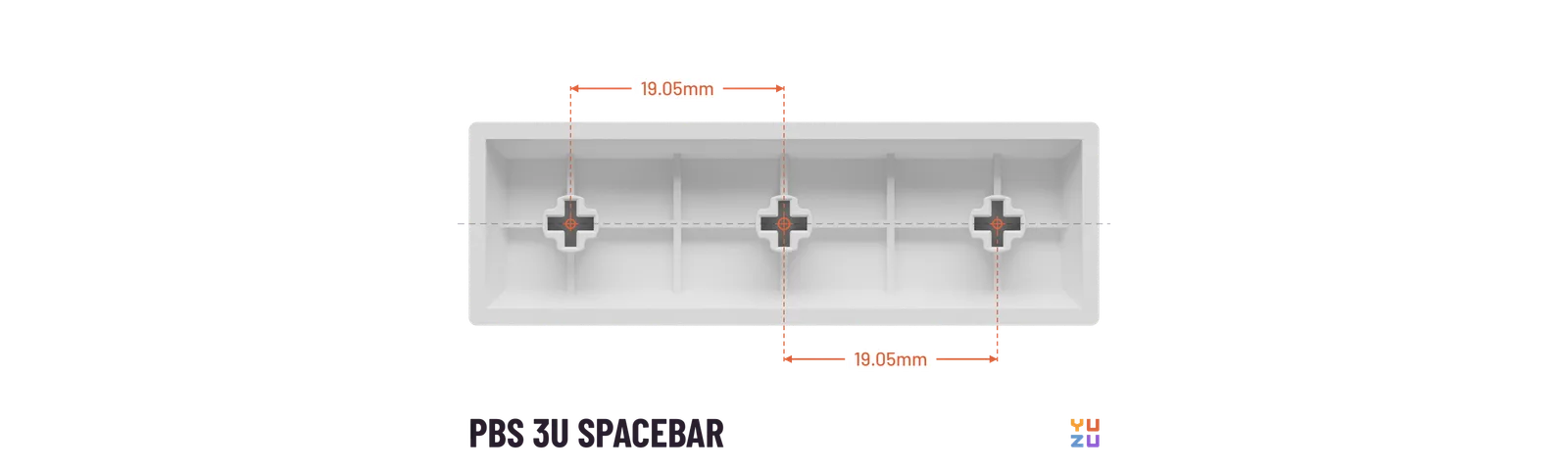
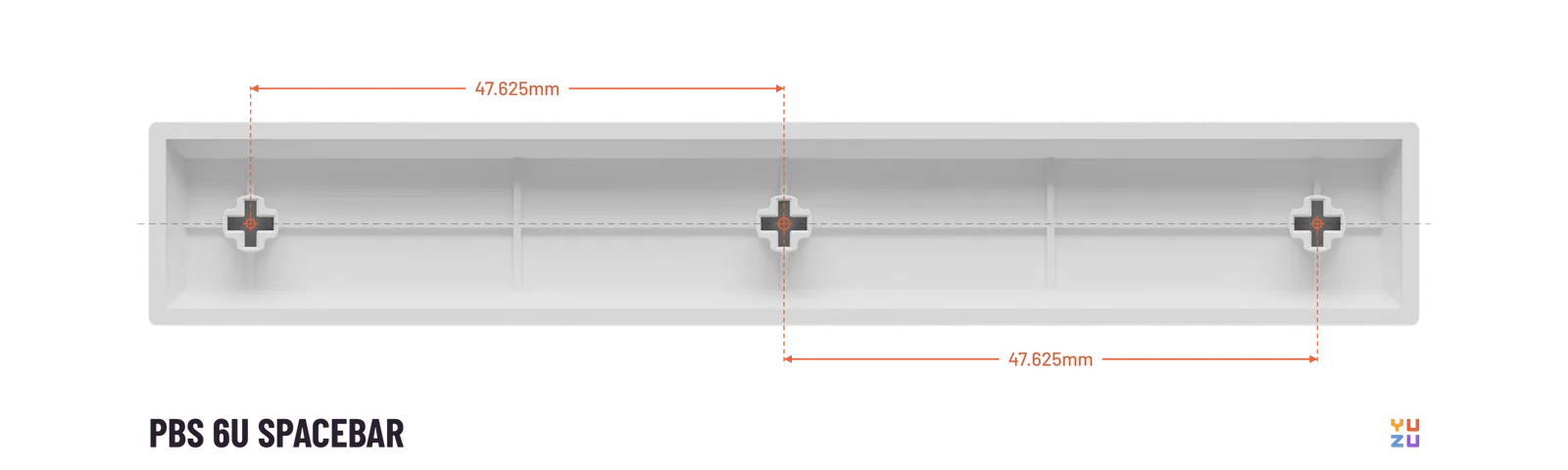
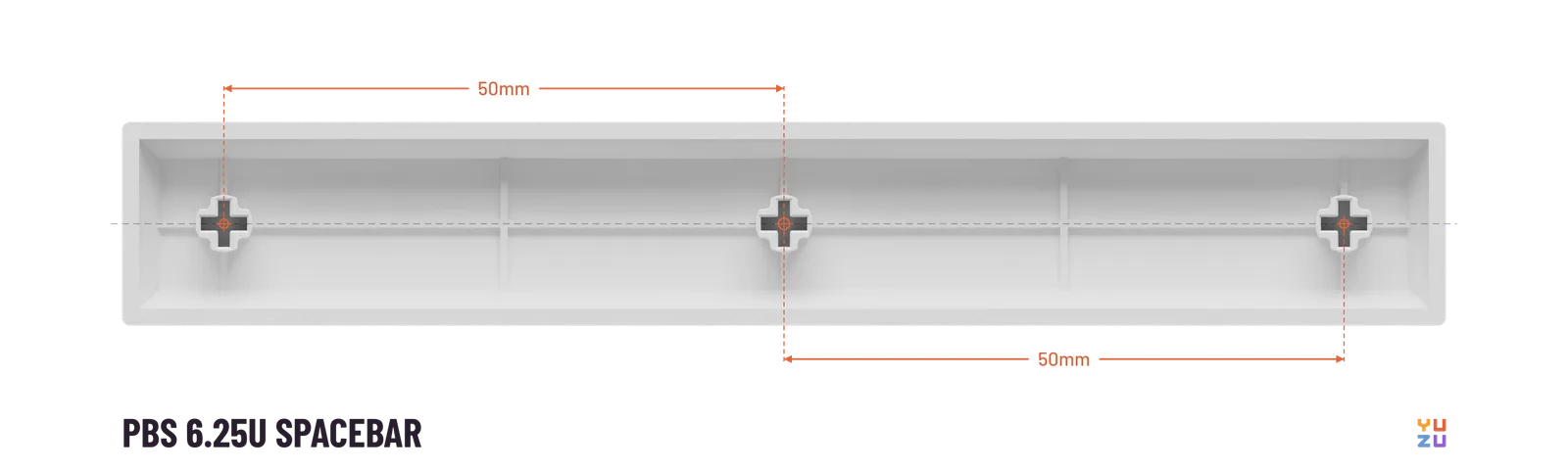
En plus de son stem central pour le switch, une barre d'espace possède des stems qui se clipsent dans les stabilisateurs de votre clavier, et elle ne s'installe que s'ils sont alignés avec les boîtiers de vos stabilisateurs. Certaines barres d'espace ont des stems supplémentaires pour d'autres positions de stabilisateurs ou pour un switch décalé. Les schémas ci-dessous montrent chaque stem de chaque barre d'espace PBS que nous fabriquons, vue de dessous (la gauche et la droite sont donc inversées), avec sa distance par rapport au stem central. Comparez-les avec votre configuration avant de commander.
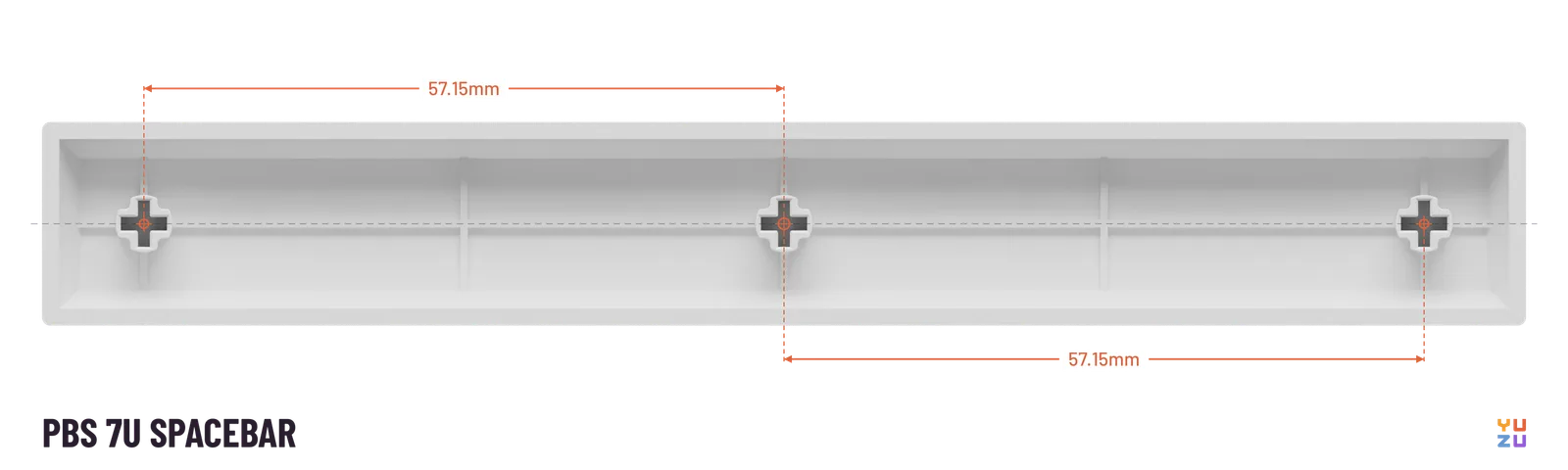
Profils de keycaps disponibles sur Yuzu
Le profil Cherry est le profil standard en ce qui concerne les touches de clavier mécaniques. Il est sculpté, ce qui signifie que chaque row a une hauteur et une forme différentes pour permettre un confort de frappe maximal. Choisissez cette option si vous n'êtes pas sûr du profil que vous préférez.
Le profil KAM a été créé par Keyreative. Il est plat, ce qui signifie que toutes les rows ont la même hauteur et la même forme pour permettre une compatibilité maximale pour échanger des touches entre les rows et différents claviers. Choisissez cette option si vous connaissez KAM ou préférez la sensation de frappe de DSA/XDA qui sont des profils de touches de clavier plats similaires.
PFF est un profil de keycaps cylindrique conçu spécifiquement pour les switchs MX à profil bas. Il répond aux exigences spécifiques des claviers à profil bas tout en conservant les avantages tactiles des keycaps profilés pour une meilleure expérience de frappe.
PBS utilise une combinaison d'un avant et d'un arrière cylindriques avec une surface de contact sphérique sur le dessus. Le résultat est une large zone de contact arrondie en haut, ce qui permet une expérience de frappe confortable et ergonomique.
Le profil KLP Lamé a été conçu spécifiquement pour les claviers ergonomiques par braindefender. Il existe en versions MX et Choc pour s'adapter à la plupart des claviers split.