Keeb.io keycaps

Keebio is a Durham, North Carolina-based keyboard company founded by Danny Nguyen (also known as BakingPy) on May 5, 2017. The brand specializes in split ergonomic keyboards and ortholinear layouts designed specifically to help people with repetitive strain injuries, carpal tunnel syndrome, and wrist pain. Starting with an initial $2,500 investment and operating from Nguyen's garage, Keebio has grown into a well-respected vendor known for making DIY mechanical keyboards accessible through hot-swap PCBs, detailed documentation, and beginner-friendly assembly processes that Nguyen describes as "like building Legos."
Custom keycaps for Keeb.io keyboards

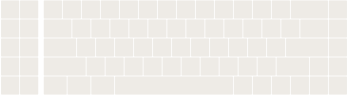

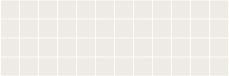
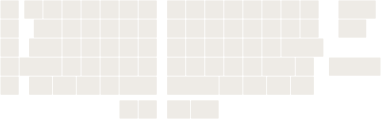
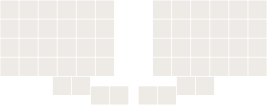
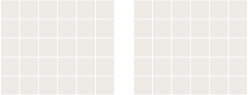


Original keycaps from Keeb.io
Keebio keyboards use standard Cherry MX-compatible stems across their entire MX lineup, making them fully compatible with aftermarket keycap sets. The company also produces low-profile variants using Kailh Choc V2 switches with MX-compatible stems, maintaining keycap compatibility across both product lines.
Most Keebio keyboards are designed to work with standard 104-key keycap sets, though users need to understand their board's specific requirements. The Iris, Keebio's flagship split ergonomic keyboard, can be completely covered by a standard full-size keycap set—users simply repurpose numpad, arrow, and navigation keycaps for the columnar layout. The Nyquist and Levinson ortholinear boards require approximately 60 1u keycaps plus optional 2u spacebars for thumb positions. The Quefrency split 65XT layout requires split spacebars (2.25u and 2.75u), which are not included in standard base kits.
Recognizing the keycap sourcing challenges for ortholinear and split ergonomic layouts, Keebio designs and manufactures their own Cherry profile PBT keycap sets specifically for these keyboards. The Cherry Icebergo (white) and Cherry Tuxergo (black) sets include all the 1u modifier keys, proper row profiles, and spacebar options needed for Iris, Nyquist, Planck, Preonic, Lily58, Sofle, and similar boards. These sets solve the common problem of standard base kits lacking sufficient 1u versions of Shift, Ctrl, Enter, and Backspace keys.
Keebio also stocks Cherry PBT split spacebar kits containing 2.25u and 2.75u convex spacebars that integrate seamlessly with GMK CYL and other Cherry profile sets, enabling full split keyboard compatibility. For the newer Choc V2-based low-profile keyboards (Iris LM, Quefrency LM), which use MX-compatible stems, Keebio carries Tai-Hao THT low-profile keycaps. These low-profile MX boards can also accept other low-profile MX profiles like PBS and PFF.
For older Choc V1 low-profile builds (early Iris variants, Dilly), Keebio stocks MBK blank keycaps and MBK Legend sets designed specifically for the Choc V1 ecosystem. Important compatibility note: Choc V1 switches use a completely different stem design and are NOT compatible with MX keycaps, PBS, PFF, or any MX-stem profiles—only Choc-specific keycaps like MBK will fit these boards.
All Keebio keyboards support QMK and VIA firmware, allowing full key remapping regardless of keycap legends. This flexibility means users can freely choose keycaps based on aesthetics and profile preference without being constrained by printed legends—a significant advantage for the heavily layered layouts common on split ergonomic boards.
Custom Keeb.io keycaps from Yuzu
Keebio keyboards accept standard MX-compatible keycaps, making them excellent candidates for full customization through Yuzu. Whether you're building an Iris, Nyquist, Quefrency, or Sinc, you can design custom dye-sublimated PBT keycaps precisely matched to your board's unique layout requirements. Our customization tools handle split keyboard complexities including ortholinear configurations, split spacebars, and the abundance of 1u modifier keys these boards require. Design keycaps in any color combination, with custom legends tailored to your specific layer configuration, and choose from profiles optimized for ergonomic typing. For Keebio's newer low-profile Choc V2 keyboards (Iris LM, Quefrency LM), Yuzu offers PBS and PFF profiles—specially designed low-profile options that work with MX-compatible stems. Note that older Choc V1 Keebio keyboards require Choc-specific keycaps and are not compatible with MX profiles.
FAQ
The Keebio Story: From $2,500 Garage Experiment to Full-Time Keyboard Company
Keebio began on May 5, 2017, when software developer Danny Nguyen (known in the community as BakingPy) set aside $2,500 to experiment with running an online keyboard parts store. Nguyen had been in the mechanical keyboard hobby for about a year, progressing from buying pre-built boards to creating custom builds and handwired keyboards. His initial inventory consisted of Cherry MX deskmats, Gateron switches, diodes, TRRS jacks, Pro Micros, and switch springs—basic components he sold from his garage in what he expected to be a temporary learning experience about e-commerce.
The turning point came shortly after launch when Nguyen designed his first keyboard PCB, the Nyquist, a 5x12 split ortholinear board. The Nyquist introduced split keyboards to a wider audience at an accessible price point with detailed documentation that made DIY keyboard building approachable for beginners. Nguyen's background in electrical engineering from Georgia Tech and his software development experience proved invaluable—he could design PCBs, write QMK firmware, and build the e-commerce infrastructure himself.
In 2018, Keebio released the Iris, a split ergonomic keyboard with columnar stagger co-designed with Lewis Ridden (GAMING_FACE), an Australian enthusiast who originated the Iris layout concept. The Iris became Keebio's signature product and one of the most popular split ergonomic keyboards in the enthusiast community. Its success stemmed from using standard MX keycaps (unlike ErgoDox's harder-to-source requirements), an attractive columnar layout that felt natural after a short adjustment period, and Nguyen's commitment to making multiple revisions with continuous improvements based on community feedback.
Throughout 2017-2020, Keebio rapidly expanded its keyboard lineup with boards targeting specific niches: the Quefrency (split 65XT with optional macro section), Levinson (split 4x6 ortho), Viterbi (split 5x7 ortho), BFO-9000 (massive split 6x9 ortho), Sinc (split 75%/TKL), Dilly (Choc 3x10 ortho), and the BDN9 (3x3 macropad). Each design addressed user requests from the community and filled gaps in the available split keyboard market. Nguyen's willingness to create niche boards that larger manufacturers ignored earned Keebio a loyal following.
In September 2020, Nguyen transitioned from part-time side business to full-time Keebio operations, moving from his garage to a dedicated office space in Durham. He hired Kayla Black as digital experience architect to handle marketing, content creation, and customer support. Keebio's mission crystallized around making split keyboards accessible not just to enthusiasts but to people suffering from repetitive strain injuries and carpal tunnel syndrome—a demographic Nguyen hadn't initially targeted but discovered through customer feedback.
The Iris Rev. 3 in late 2018 marked a major advancement: integrated microcontrollers replaced Pro Micros, reducing soldering requirements and improving reliability. Subsequent revisions added hot-swap sockets (eliminating soldering entirely for many builds), per-key RGB, VIA support for real-time keymap editing, and rotary encoder options. By 2021, Keebio keyboards had evolved from advanced DIY projects into beginner-friendly kits that customers could assemble with just a screwdriver.
Recognizing that keycap availability was the primary barrier for split and ortholinear keyboard adoption, Keebio began designing their own keycap sets around 2022-2023. The Cherry Icebergo and Cherry Tuxergo sets provided complete Cherry profile coverage for ortho and ergo boards with all necessary 1u modifiers and spacebar options—solving a sourcing problem that had plagued the community for years.
In 2024-2025, Keebio focused on low-profile keyboards with the Iris CE (Choc Edition), Iris LM (Low-profile MX using Choc V2 switches with MX stems), and Quefrency LM, responding to demand for portable, low-profile split keyboards that maintained standard keycap compatibility. The company also released pre-built options including the Iris SE (Standard Edition, pre-assembled) to serve customers who wanted the ergonomic benefits without the DIY assembly process.
Today, Keebio remains a small, community-focused company shipping keyboards worldwide from their Durham facility. Nguyen continues to design new boards, maintain extensive documentation on docs.keeb.io, write detailed blog posts about the design process, and engage directly with customers on Discord and Reddit. The company's 2-year warranty, commitment to open-source firmware (QMK/VIA), and emphasis on repairability with replaceable parts distinguish Keebio in an industry increasingly dominated by planned obsolescence.