ZSA keycaps

ZSA Technology Labs was founded in Canada in 2015 by Erez Zukerman and co-founders Andrew Aitken and Dmitry Slepov, with a mission to create ergonomic split mechanical keyboards that prioritize typing health and long-term usability. The company launched with a successful Indiegogo crowdfunding campaign for the ErgoDox EZ and has since expanded to a three-keyboard lineup: the classic ErgoDox EZ, the modular Moonlander, and the ultra-thin Voyager. ZSA distinguishes itself through exceptional long-term product support, pioneering hot-swappable switch sockets (introduced in 2017), open-source QMK firmware, and a philosophy that keyboards should be repairable and upgradable rather than disposable. Based in Kitchener-Waterloo, Ontario, ZSA has sold over 100,000 keyboards to professionals worldwide.
Custom keycaps for ZSA keyboards
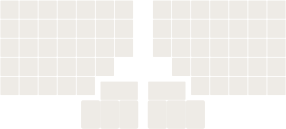
Original keycaps from ZSA
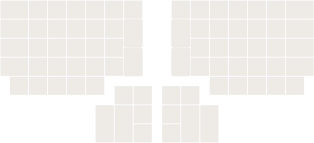
ZSA keyboards ship with high-quality doubleshot PBT keycaps manufactured by Tai-Hao, a leading Taiwanese keycap producer. Customers choose between two keycap styles when ordering: printed (with alphanumeric legends) or blank (light-shine-through lines only).
Printed keycaps use a uniform profile across all rows, meaning every keycap has identical height and shape. This design decision serves a practical purpose: it allows users to physically rearrange keys for alternative layouts like Colemak, Dvorak, or Norman without profile mismatches. The uniform profile makes ZSA's printed caps among the most flexible stock keycaps available for layout experimentation.
Blank keycaps are sculpted with different profiles per row. The ErgoDox EZ's blank caps use DCS profile (a sculpted cylindrical profile with varying row heights), while the Moonlander's blanks are also sculpted to match finger reach patterns. Sculpted keycaps provide ergonomic advantages—each row's distinct angle and height guide fingers naturally—but cannot be freely rearranged between rows. ZSA recommends printed caps for beginners and those planning to use non-QWERTY layouts, while blank sculpted caps suit touch typists who want maximum ergonomic contouring.
Voyager keycaps differ significantly: this low-profile board uses Kailh Choc V1 switches exclusively, requiring Choc-specific keycaps that are incompatible with standard MX switches. The Voyager ships with custom doubleshot PBT Choc keycaps made by Tai-Hao, designed specifically for the board's ultra-thin profile. Aftermarket keycap options for the Voyager are limited to Choc V1-compatible sets like MBK.
Material and Manufacturing
All ZSA keycaps use doubleshot PBT construction. Doubleshot molding means legends are formed from a second layer of plastic molded through the keycap—they physically cannot fade or wear off. PBT (polybutylene terephthalate) plastic offers superior durability compared to ABS, resists developing surface shine over time, and produces a muted, satisfying "thock" sound. The doubleshot process combined with PBT material puts ZSA's stock keycaps significantly above typical pre-built keyboard quality.
Compatibility and Replacement Options
ErgoDox EZ and Moonlander both use standard Cherry MX-compatible stems and accept any MX keycap set. However, their unusual layouts present compatibility challenges:
ErgoDox EZ requires 1.5u outer column keys and 2u vertical thumb keys—sizes not included in standard keycap base kits. YMDK and other vendors sell dedicated ErgoDox-compatible sets, typically in DSA or other uniform profiles. The ErgoDox's split spacebar arrangement and 80-key layout demand careful planning when sourcing aftermarket caps.
Moonlander uses primarily 1u keys but features 1.5u "piano key" thumb keys and a 2u "Launch" thumb key with Costar stabilizer. The articulating thumb cluster's unique positioning makes finding perfectly matched aftermarket caps challenging. Most users stick with ZSA's stock caps or opt for uniform-profile sets (DSA, XDA) that work regardless of row assignment.
ZSA does not currently sell replacement keycap sets separately through their website, though customers report success contacting support for individual replacement keys. For full custom sets, users typically source from aftermarket keycap vendors, with uniform profiles strongly recommended due to the non-standard columnar layouts.
Custom ZSA keycaps from Yuzu
All ZSA keyboards accept standard MX-compatible keycaps (except the Voyager, which requires Choc V1 caps), making them excellent candidates for full customization with Yuzu. Whether you're personalizing an ErgoDox EZ, Moonlander, or Voyager, Yuzu's dye-sublimated PBT keycaps can be designed to precisely match your board's unusual layout requirements. Our customization tools support all ZSA keyboard configurations, letting you create keycaps in any color combination, with custom legends optimized for your specific layer setup, and in your choice of profile—critical for boards where standard keycap kits fall short on compatibility.
FAQ
The Journey from Open-Source to Industry Leader
ZSA Technology Labs' origin story begins not with the company itself, but with an open-source keyboard design called the ErgoDox, created by Dominique "Dox" Maltais. The original ErgoDox required users to source components, assemble PCBs, hand-wire switches, and flash firmware—a barrier that kept ergonomic split keyboards confined to the most dedicated hobbyists.
Erez Zukerman, a self-described procrastinator and writer, discovered the ErgoDox while searching for ways to improve his typing efficiency and comfort. Frustrated by the complexity of building one himself, he saw an opportunity: what if someone made the ErgoDox accessible to professionals who wanted ergonomic benefits without DIY assembly? In May 2015, Zukerman launched an Indiegogo campaign for the ErgoDox EZ ("EZ" for "easy")—a fully assembled, professionally manufactured version of the open-source design. The campaign succeeded, and ZSA Technology Labs was formally incorporated in September 2016.
The ErgoDox EZ distinguished itself through continuous improvement rather than planned obsolescence. In 2017, ZSA became one of the first keyboard manufacturers to offer hot-swappable switch sockets, allowing users to change switches without soldering—a feature now considered standard but revolutionary at the time. While other companies might have treated this as a "version 2.0" requiring repurchase, ZSA retrofitted the feature across all units and committed to backward firmware support for early backers. Original 2015 Indiegogo ErgoDox EZ keyboards still receive firmware updates in 2025.
For several years, the ErgoDox EZ was ZSA's sole product. Then in 2020, the company launched the Moonlander, their first proprietary design. Unlike the open-source ErgoDox, the Moonlander introduced articulating thumb clusters—entire sections that pivot independently to match natural thumb movement. The modular "Wing" wrist rest system, thinner profile, full per-key RGB backlighting, and refined columnar layout represented ZSA's evolution from manufacturing someone else's design to creating their own ergonomic philosophy in hardware.
The Voyager followed as ZSA's answer to portable split ergonomics. At just a few millimeters thick with Kailh Choc low-profile switches, the Voyager packs into carry-on bags while maintaining ZSA's commitment to hot-swap capability, QMK firmware, and Oryx configuration. The Voyager marked ZSA's expansion into the low-profile market and demonstrated that aggressive size reduction doesn't require sacrificing adjustability or build quality.
Throughout this evolution, ZSA maintained its defining characteristics: made-to-order manufacturing (reducing waste), extensive QMK firmware support with the web-based Oryx configurator (lowering the barrier to firmware customization), exceptional customer service (CEO Erez Zukerman still personally responds to support emails), and a two-year warranty extendable to four years. In 2024, ZSA upgraded the ErgoDox EZ to the same STM processor used in the Moonlander and Voyager, increasing memory from 32KB to 256KB—an 8x improvement for a nearly decade-old product that most companies would have discontinued.
By 2025, ZSA had sold over 100,000 keyboards globally, primarily to software developers, writers, and professionals spending 8+ hours daily at keyboards. The company carved out a unique position: not the cheapest split keyboards available, not the most compact, but the most thoughtfully supported, with a community-driven philosophy inherited from the ErgoDox's open-source roots. ZSA actively sponsors QMK firmware development, maintains detailed blog documentation on ergonomics and firmware features, and treats every keyboard as a long-term investment rather than a disposable consumer product.