Nuphy keycaps

NuPhy is a Chinese keyboard manufacturer based in Shenzhen, founded in 2020 by a team of enthusiasts determined to bridge the gap between premium typing experience and modern aesthetics. The brand specializes in wireless mechanical keyboards that prioritize portability, low-profile design, and Mac compatibility. NuPhy gained rapid recognition through their innovative Air series keyboards that combine mechanical switches with ultra-slim form factors, and their proprietary nSA keycap profile designed specifically for low-profile ergonomics. The company's mission centers on creating keyboards that deliver desktop mechanical keyboard performance in laptop-thin packages, with careful attention to wireless connectivity, dual-OS support, and minimalist industrial design.
Custom keycaps for Nuphy keyboards
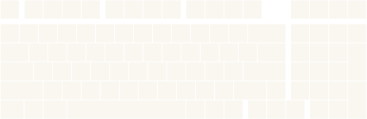
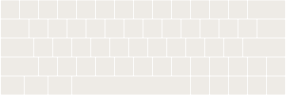
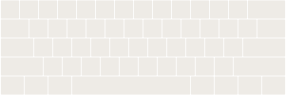
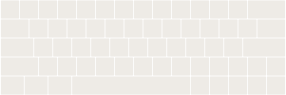
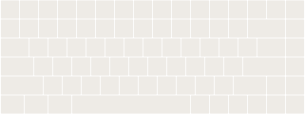
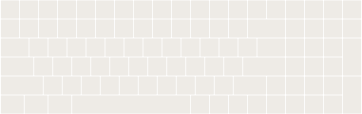
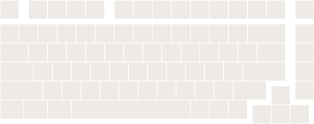
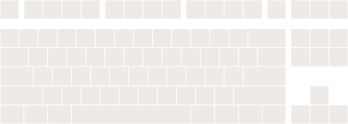
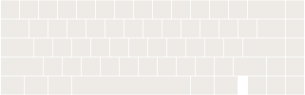
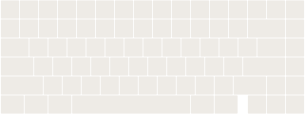
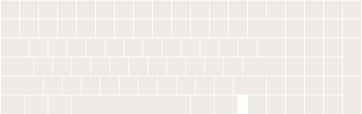
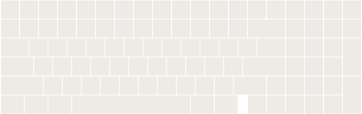
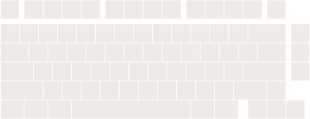
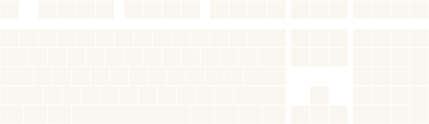

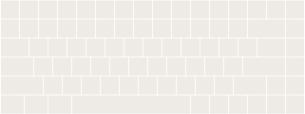
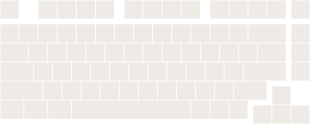
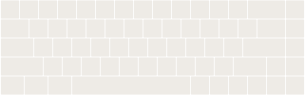
Original keycaps from Nuphy
NuPhy produces keyboards across two distinct switch ecosystems: low-profile keyboards using MX-compatible low-profile switches and standard-profile keyboards using standard Cherry MX switches. Each ecosystem uses different keycap heights but shares MX stem compatibility.
Low-Profile Keyboards (Air Series, Kick75 Low-Profile)
The Air series keyboards ship with NuPhy's proprietary nSA profile keycaps — a low-profile design developed specifically for MX-compatible low-profile switches. These keycaps feature a curved top surface that maintains close finger contact while reducing typing stress, with a gradual 6-row slope that minimizes finger travel. The material is PBT with dye-sublimated legends, offering grease and scratch resistance with vibrant color detail.
In 2024, NuPhy introduced the Berry profile — a Cherry-inspired low-profile keycap designed to deliver familiar Cherry height and feel on low-profile keyboards while maintaining enhanced precision for competitive gaming. Berry keycaps use the same PBT dye-sub construction as nSA but with more pronounced sculpting and streamlined height. Sets include 160 keycaps.
Both nSA and Berry keycaps use standard MX stems but are designed for low-profile switch spacing and heights. They are compatible with other MX-stem low-profile switches (Gateron Low Profile, Cherry Low Profile, Kailh Choc V2) but will not be a perfect fit for standard-height MX switches due to the reduced keycap height.
Standard-Profile Keyboards (Halo Series, Field Series, Gem80)
Halo series keyboards ship with Cherry profile keycaps made from PBT with either dye-sublimated or doubleshot legends. Some premium models like the Halo65 V2 use NuPhy's mSA profile — a modified SA design with adjusted height for improved ergonomics, larger rounded surfaces, and light-emitting homing bars illuminated by south-facing LEDs. Standard Halo keycaps include 148-160 keys supporting 60%, 75%, and 96% layouts.
The Field75 HE and Halo HE models feature Cherry profile doubleshot PBT keycaps specifically designed for RGB backlighting compatibility.
Hall Effect Keyboards
NuPhy's magnetic switch keyboards (Air75 HE, Halo65 HE, Field75 HE) use the same keycap profiles as their mechanical counterparts — low-profile HE boards use nSA or Berry, while standard-profile HE boards use Cherry. All Hall Effect keyboards maintain standard MX stem compatibility for their respective profile heights.
Replacement Keycaps
NuPhy sells replacement keycap sets through their website and retailers. Low-profile sets (nSA and Berry profiles for Air series) retail for $39-49, while standard Cherry profile sets cost $49. They offer themed colorways, shine-through variants (polycarbonate with painted surfaces), and novelty sets.
Third-party keycap compatibility: Low-profile Air keyboards accept MX-stem low-profile keycaps from other manufacturers (though selection is limited compared to standard-profile options). Standard-profile keyboards accept any standard MX keycaps. Important note: Standard-height MX keycaps will not work on Air series keyboards due to height mismatch, and low-profile keycaps will not work properly on standard-height keyboards.
Customization Note
Both NuPhy's low-profile and standard-profile keyboards use MX-compatible stems, but require different keycap heights. Standard-profile keyboards (Halo, Field, Gem) accept any standard MX-compatible aftermarket keycaps, making them excellent candidates for full customization with services like Yuzu Keycaps. Low-profile Air series keyboards require MX-stem low-profile keycaps specifically — a smaller but growing aftermarket segment. Yuzu can create custom dye-sublimated PBT keycaps precisely matched to any MX-compatible NuPhy keyboard's layout, offering unlimited color combinations, custom legends, and appropriate profile choices for both low-profile and standard-height models.
Custom Nuphy keycaps from Yuzu
NuPhy keyboards span two distinct categories with different keycap requirements. For low-profile Air series keyboards (Air60, Air75, Air96), Yuzu offers PFF and PBS profiles — both designed specifically for low-profile MX switches at 5mm and 7.5mm heights respectively, providing a perfect fit for Air keyboards' reduced switch heights. For standard-profile keyboards like the Halo65, Halo75, Field75, or Gem80, Cherry and KAM profiles deliver optimal typing feel and compatibility. Our customization tools support all NuPhy keyboard layouts across both profile heights, letting you create keycaps in any color combination with custom legends. Whether you're customizing a portable Air75 or a premium Halo65, Yuzu delivers professional-quality dye-sublimated PBT keycaps matched precisely to your board's specifications.
FAQ
The Evolution of NuPhy: From MacBook Accessory to Mechanical Keyboard Leader
NuPhy's origin story begins with a satisfied MacBook user who became disillusioned by a controversial design change. After purchasing an 11-inch MacBook Air in 2010, the brand's founder initially loved the device, calling it the first consumer electronics product he'd seen "made into a work of art." The keyboard posed no issues — he was accustomed to thin membrane keyboards and hadn't yet discovered mechanical switches.
That changed in 2015 when Apple introduced the Butterfly Keyboard on the latest MacBook generation. Despite widespread media skepticism, the founder purchased a new MacBook with the Butterfly mechanism, confident he could adapt. Apple's track record with the iPod, iPhone, and iPad suggested the company's design decisions would prove prescient. This time, however, the bet didn't pay off. The Butterfly keyboard's shallow key travel was merely uncomfortable — the critical flaw was reliability. Dust intrusion caused keys to fail, requiring multiple presses to register. Frustration mounted until the founder began searching for external keyboard solutions.
His discovery of mechanical keyboards was revelatory. The tactile feedback and reliability created what he described as "the illusion that typing on a mechanical keyboard was a finger dancing on the keyboard." But existing mechanical keyboards were too bulky for mobile use. The contradiction was clear: mechanical switches delivered superior typing, but their form factor defeated the MacBook's portability. This gap became NuPhy's founding premise.
Development and Hard Cider Labs Partnership
The journey from concept to product took nearly a year of intensive development. Working with industrial design firm Hard Cider Labs for over nine months starting in 2019, the team refined their first keyboard through hundreds of iterations. Hard Cider Labs brought crucial crowdfunding experience and a philosophy of perfectionism. When the founder received the first trial production sample in January 2019 with molds already cut, Hard Cider Labs made a critical intervention: they stopped the launch.
"They told me about their crowdfunding experience and warned me that if I went online crowdfunding before the product reached perfection, it would probably ruin my life and the brand," the founder later wrote. The team spent an additional 287 days identifying and solving product issues. "I think it's totally correct I didn't blindly start crowdfunding at that time. Otherwise, NuType will probably be labeled 'Scam' today."
By late 2019, after using the NuType daily for over two months and distributing samples to friends who reported using it "every day," the team determined the product was ready.
The NuType Kickstarter Success
NuPhy launched their crowdfunding campaign for the NuType F1 on November 12, 2019, targeting HK$80,000. The response exceeded all projections: the campaign raised HK$1,300,357 from 1,611 backers — over 1,625% of the funding goal.
The NuType F1 was genuinely innovative: a 64-key low-profile mechanical keyboard using Kailh Choc switches designed to sit directly on top of a MacBook's built-in keyboard, locked in place by notches that fit between the laptop keys. It didn't cover the Touch Bar or function row, allowed uninterrupted trackpad use, and came with a magnetic SmartCase that folded into a stand. Priced at $99-149 retail, it targeted mobile professionals wanting mechanical keyboard feel without sacrificing portability.
The NuType established design principles that would define all future NuPhy products: ultra-slim profiles, wireless connectivity (Bluetooth + 2.4GHz), Mac-first design with Windows compatibility, and minimalist industrial aesthetics. The product shipped to backers starting February 2020.
Product Line Expansion and the Air Series Breakthrough (2020-2022)
Following the NuType's success, NuPhy rapidly expanded beyond the MacBook-overlay concept to standalone keyboards. The Air75 became a breakout hit around 2021-2022, gaining viral attention through YouTube channels (particularly "Scatter TV Naoshima") and establishing 75% as NuPhy's signature form factor. The Air75 introduced the unibody aluminum frame design and distinctive sidelights that became NuPhy trademarks.
When Japanese distributor Sanyo Godo Kaisha brought NuPhy products to Japan, the Air75's popularity exploded, cementing NuPhy's position in the enthusiast market. The ultra-thin profile (under 1 inch), portability, and pop-inspired colorways resonated with users seeking mechanical keyboards that didn't dominate desk space.
The Air series grew to include Air60 (60%), Air75 (75%), and Air96 (96%) layouts, all sharing the low-profile philosophy and NuPhy's proprietary nSA keycap profile — a design that addressed ergonomics specific to low-profile typing with curved tops and gentle 6-row sculpting. The nSA profile would become so influential that competitors began imitating it.
Premium Expansion: The Halo Series (2022-2023)
By 2022, NuPhy had developed sufficient market credibility to launch the Halo series — standard-height keyboards aimed at users wanting premium build quality without sacrificing wireless performance. The Halo65, announced in late 2022, represented a radical design departure: a unibody aluminum frame meeting a laser-polished ABS base unified by the "Halolight" illumination band.
The Halo65 introduced acoustic innovations inspired by the custom keyboard community: plate silicone, PCB silicone, bottom silicone, and spacebar silicones for comprehensive sound dampening. It shipped with pre-lubed Gateron G Pro 2.0 switches and featured NuPhy's first proprietary switches — Night Breeze (linear) and Rose Glacier (tactile) — with polyketone (POK) stems for improved elasticity and durability. The electrophoretic white colorway, typically reserved for high-end customs costing hundreds of dollars, demonstrated NuPhy's manufacturing ambition.
Firmware Revolution: QMK/VIA Adoption (2022-2023)
Starting with the Air75 V2 around 2022-2023, NuPhy made a strategic pivot to QMK/VIA firmware for full open-source customization. This decision signaled NuPhy's commitment to the enthusiast community over proprietary control. QMK/VIA support became standard across Air V2/V3, Halo V2, and all newer keyboard lines, enabling unlimited key remapping, macro programming, and lighting control through browser-based configuration.
The move to QMK positioned NuPhy alongside enthusiast brands like Keychron while differentiating from gaming-focused manufacturers locked into proprietary software.
Hall Effect and Gaming Innovation (2024-2025)
NuPhy entered the magnetic switch market with Hall Effect variants across multiple product lines. The Air60 HE, Air75 HE, Halo65 HE, and Field75 HE keyboards adopted adjustable actuation points (0.1mm to 4.0mm), Rapid Trigger technology (instant reset on key release), and 8000Hz polling rates — wireless latency performance matching wired gaming keyboards.
The Halo65 HE showcased NuPhy's switch development capabilities with proprietary Magnetic Jade Pro (rare-earth magnets in metal casing for competitive gaming) and Magnetic Coral switches (coral housing matching Halo aesthetics). NuPhy developed custom NuPhyIO software for gaming-specific features: visualized dead zone configuration, RapidSwitch mode management (different profiles per game/OS), and animated sensitivity adjustments.
Benchmark tests demonstrated the Air75 V3 achieving wireless latency competitive with premium wired keyboards, dispelling the myth that low-profile keyboards sacrifice performance.
Keycap Innovation and Profile Development
NuPhy's keycap development became a core differentiator. Beyond the original nSA profile, they introduced:
- Berry profile (2024): Cherry-inspired low-profile keycaps delivering familiar sculpting and height on low-profile switches, designed specifically for competitive gaming precision
- mSA profile (2024): Modified SA with adjusted height for improved ergonomics, larger rounded surfaces, and proprietary light-emitting homing bars using triple-shot injection molding — LED-illuminated guidance bars visible even in darkness
- Multiple finish innovations: standard dye-sub PBT, doubleshot PBT, shine-through polycarbonate with painted surfaces, and electrophoretic coatings
Current Position and Market Impact (2025)
As of 2025, NuPhy operates nine distinct product lines: Air (low-profile portability), Halo (premium standard-profile), Field (gasket-mount enthusiast), Gem (80% layout), Nos (compact premium), BH (hybrid profile), Kick (hybrid profile with volume knob), Node (full-size low-profile), and WH (wireless high-profile). The brand maintains a strong community presence with 132K Instagram followers (@nuphy.studio), active customer support, and regular firmware updates through NuPhyIO.
Their product strategy balances accessibility (Air series keyboards starting around $100-130) with premium positioning (Halo V2 and Hall Effect models at $200-250+), serving both keyboard newcomers seeking Mac-compatible alternatives and seasoned enthusiasts demanding gasket mounts, QMK, and hot-swap functionality.
Manufacturing remains in Shenzhen, benefiting from proximity to keyboard component suppliers and contract manufacturers. NuPhy's ability to implement challenging manufacturing processes like electrophoretic coating and triple-shot injection molding at competitive price points reflects Shenzhen's manufacturing infrastructure advantages.
Legacy and Influence
The evolution from a single crowdfunded MacBook accessory to a comprehensive keyboard manufacturer with 15+ active product lines demonstrates NuPhy's success in identifying and serving underserved niches — particularly low-profile mechanical keyboards, Mac-first design, and wireless performance. Their proprietary keycap profiles (nSA, Berry, mSA) have been widely imitated, establishing NuPhy as a design leader rather than follower.
The brand's emphasis on wireless technology advancement challenged industry assumptions: their demonstration that low-profile keyboards could achieve sub-5ms latency and 8000Hz polling rates wirelessly repositioned low-profile from "portable compromise" to "legitimate performance option." NuPhy proved that portability and performance weren't mutually exclusive — a philosophy that continues to define their product development.